

Dental stripping, also known as IPR, is an orthodontic technique that involves carefully reducing the enamel between teeth to create more space. An orthodontist performs this procedure by slightly narrowing certain teeth, usually by 0.2 to 0.5 millimeters, to help with alignment. It’s a common and safe practice, used both with and without braces, mainly for patients with crowding issues. If you’re looking for a dentist in Palma de Mallorca, you can find experienced professionals at our dental clinic who can perform this technique effectively.
When is dental stripping performed in orthodontics?
Despite the various applications of stripping in dentistry, its primary use is in orthodontics. It is mainly applied in situations where it is essential to gain space to align the teeth without exceeding the biological limits of each patient. It is crucial to mention that interproximal reduction is carried out selectively, limited to certain teeth and only eliminating a small portion of the tooth. Stripping is particularly useful in cases of crowding, where the reduction in the width of the teeth helps to solve spacing problems in a practical and simple way. This process is completed in minutes and is painless for the patient. However, there are situations where more space is required, leading to the consideration of other methods, which will be described later.
Uses of Dental IPR
In addition to gaining space, dental IPR is used in orthodontics to reduce black triangles between the teeth, known as embrasures. Some patients present small dark areas between the teeth that are in contact, which can occur when the teeth have a triangular shape or due to the loss of dental papilla. In these cases, stripping is effective in eliminating contact between the teeth in the area where the triangle is created, allowing for a more square-shaped contour, where the edges are aligned parallelly.
How is dental stripping performed?
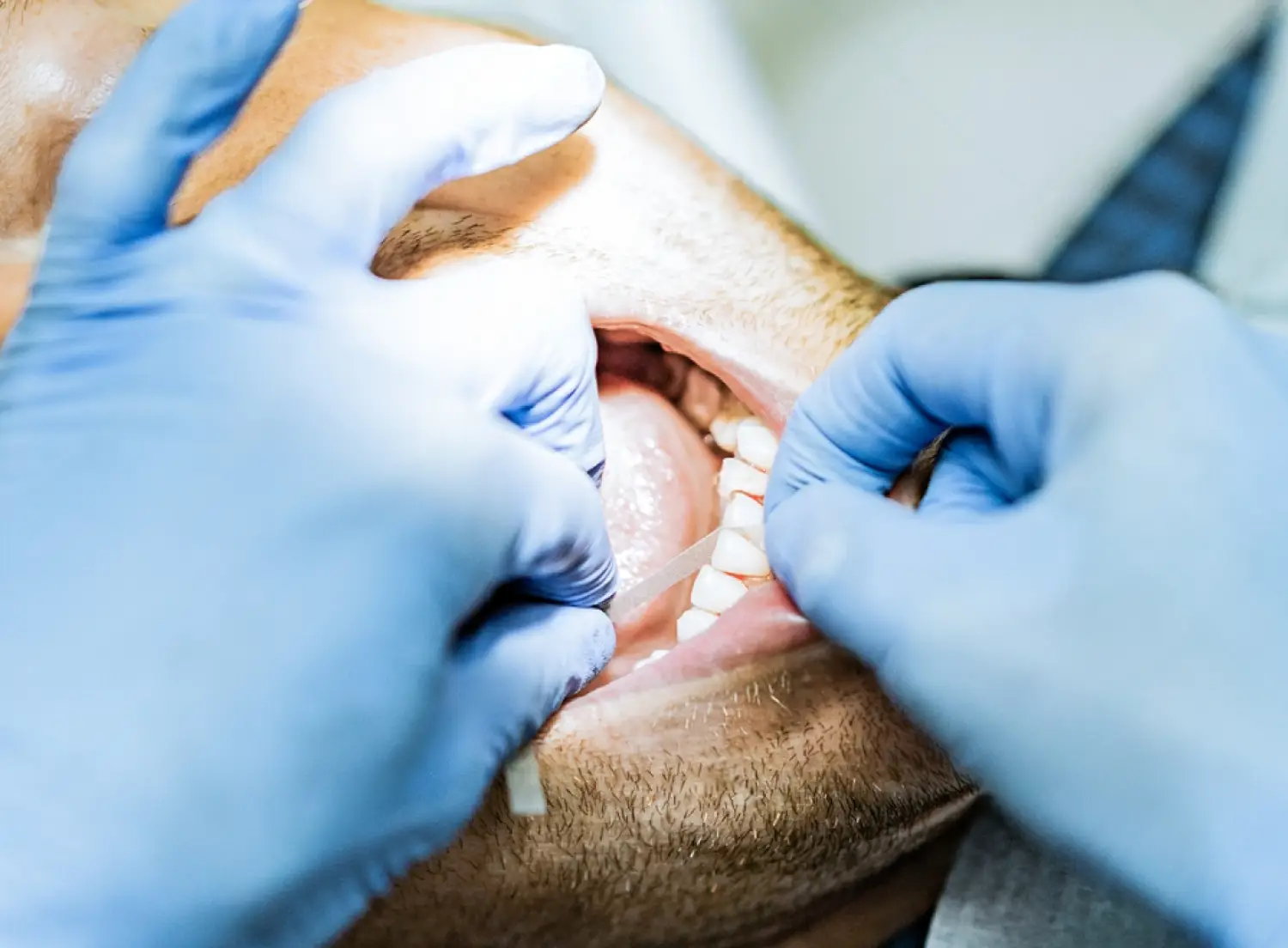
Stripping can be carried out in both the upper and lower arches. The orthodontist has several methods to perform this procedure, and the choice of the appropriate method will depend on the preferences of the professional and the amount of enamel that needs to be removed. The available instruments include:
- Polishing strips: This manual method is quite simple and allows for less reduction of enamel, so it is sometimes necessary to combine it with another technique that generates more space.
- Polishing burs: This mechanical procedure facilitates greater reduction of space. However, given this advantage, it is essential that the professional is properly qualified to avoid excessive removal of dental tissue.
Once the treatment is completed, the interproximal reduction will be evident, as small spaces will appear between the teeth. These spaces will be practically invisible to others and will have a limited duration thanks to the micromovements of the teeth that occur during orthodontic treatment. Over time, the spaces will close until all the teeth are completely aligned. While these slight gaps remain, it is vital to maintain good oral hygiene to prevent food residues from accumulating between the teeth. The use of cleaning tools such as interdental brushes or oral irrigators is especially beneficial in these cases.
Does stripping hurt?
When informing patients about the need for this treatment, many feel anxious about the idea of having their teeth “filed.” However, it is important to clarify that it is a conservative technique and does not cause pain. Although the patient may feel some discomfort, as it may seem like their teeth are being filed, they will not actually experience pain, as dental enamel lacks nerve endings and works exclusively on its outer layer. In fact, anesthesia is not required during the procedure.
Is it an aggressive procedure for the tooth?
When performed correctly, interproximal reduction is a safe procedure for the teeth. Although it involves the removal of part of the dental enamel, this action represents only a tiny fraction of the total thickness of the enamel. It is essential to choose a trusted professional to carry out any dental treatment. If stripping makes you uncomfortable, we suggest that you trust the orthodontist’s judgment, relax, and close your eyes during the procedure.
Are there other procedures to gain space?
Apart from stripping, there are various techniques for gaining space that orthodontists can use. These include:
- Arch expansion: This technique involves increasing the length of the arch using fixed or removable devices.
- Incisor protrusion: This increases space by moving the incisors slightly forward with fixed or removable devices.
- Tooth extraction: While stripping is used to remove a small part of the enamel thickness, extractions can provide an increase of between 8 and 10 mm of space.
Is IPR better than other space-gaining techniques?
Once you understand the concept of stripping and its applications in orthodontics, it is essential to consider another aspect. Although this technique is known for its simplicity and effectiveness, it is not necessarily more or less drastic than other methods to gain space. Often, patients feel intimidated when they hear about the need for extractions and feel relieved when stripping is suggested. The key in orthodontics is personalized treatment planning according to the needs of each patient. Thus, an extraction should not be considered an aggressive procedure if the treatment plan requires it due to a significant need for space. If avoiding extraction jeopardizes the health of other teeth, compromises the stability of the treatment, or delays it without justification, it would be a mistake not to consider it.
In cases where it is crucial to gain considerable space, it would not be reasonable to sacrifice the amount of enamel needed or try to reduce interproximal space in all teeth. It is worth remembering that dental stripping offers a reduction of between 0.2 and 0.5 mm, while an extraction can provide a space of between 8 and 10 mm. For this reason, if you have a dental crowding problem and want to align your smile, it is advisable to visit a trusted orthodontist. Once in the clinic, an analysis of your specific situation can be carried out and determine which technique is best suited to your dental needs.