

Wisdom tooth removal is a common dental procedure, but not every extraction involves the same level of difficulty. When removing lower wisdom teeth, one important consideration is how close the tooth roots are to a nerve running through the jawbone. In some patients, this relationship can make the procedure more complex and increase the risk of altered sensation in the lower lip or chin.
Before recommending an extraction, a dentist can assess the position of the tooth using a clinical examination and appropriate dental imaging. In certain situations, a 3D dental CT scan, also known as cone beam computed tomography (CBCT), may provide valuable information about the relationship between the wisdom tooth roots and the nerve.
However, does every patient need a CT scan before wisdom tooth removal? And what happens if the roots are touching or extremely close to the nerve?
Which nerve can be affected during wisdom tooth removal?
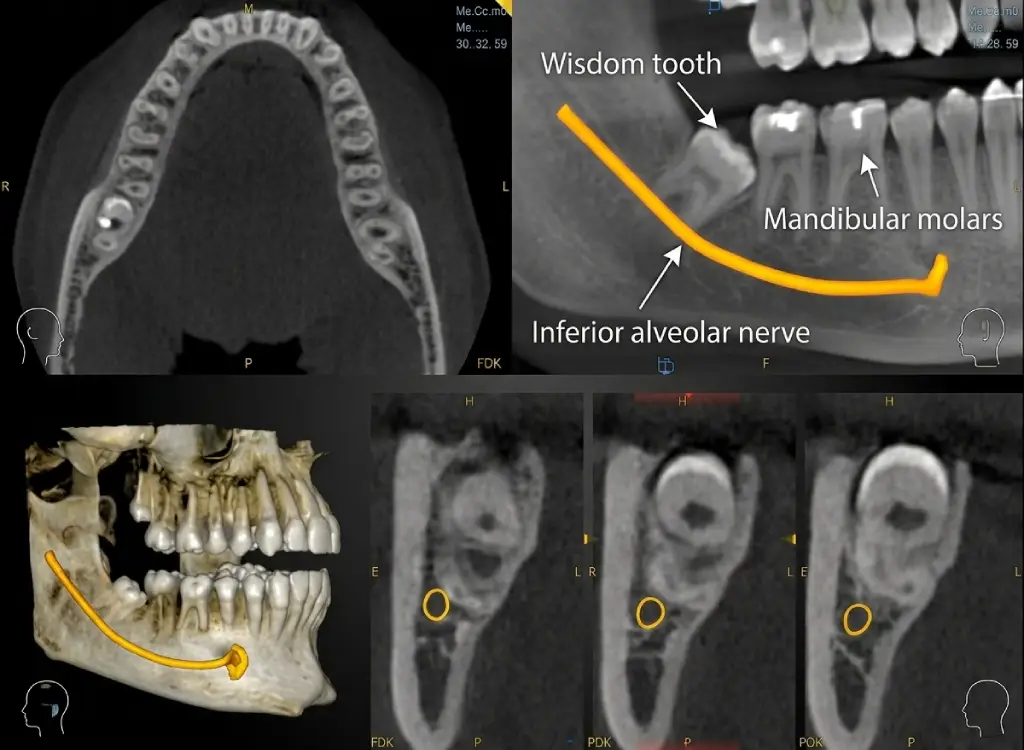
Lower wisdom teeth, also called third molars, develop at the back of the lower jaw. Running through the jawbone is the inferior alveolar nerve, which travels inside a bony channel known as the mandibular canal.
This nerve supplies sensation to the lower teeth and, through its branches, to the lower lip and chin.
The distance between the roots of a lower wisdom tooth and the mandibular canal varies considerably from person to person.
In some patients, there is a clear separation between the roots and the canal. In others, the roots may be extremely close to it or even in direct contact with the canal.
Occasionally, the anatomy is more complicated, with roots appearing to curve around or partially surround the nerve canal.
When this happens, understanding the exact position of these structures becomes particularly important before planning an extraction.
Can wisdom tooth removal cause numbness in the face?
Yes, although nerve injury is not a common complication of every wisdom tooth extraction. The risk depends on several factors, including the position of the tooth, the shape of its roots and their relationship with the inferior alveolar nerve.
If this nerve is affected during the procedure, patients may experience:
- Numbness in the lower lip.
- Reduced sensation in the chin.
- Tingling or a pins-and-needles sensation.
- Unusual sensations when touching the affected area.
- Altered sensitivity in the lower teeth or surrounding gum tissues.
These sensory changes may include paraesthesia, a term used to describe abnormal sensations such as tingling or pins and needles.
When a nerve injury occurs, sensation may gradually return over the following weeks or months. However, some injuries can cause long-lasting or permanent sensory changes.
It is important to clarify a common misconception: injury to the inferior alveolar nerve does not normally cause numbness across the entire face. The main areas affected are typically the lower lip and chin on the same side as the extraction.
Why might a 3D CT scan be useful before wisdom tooth removal?
A panoramic dental X-ray, also known as an orthopantomogram or OPG, is commonly used to evaluate wisdom teeth before extraction.
This image provides an overview of the teeth, jawbone, roots and approximate position of the mandibular canal.
However, a panoramic X-ray is a two-dimensional image. Structures that appear to overlap may actually be separated in three dimensions.
For example, the roots of a wisdom tooth may appear to cross the nerve canal on an X-ray, even when they are positioned in front of or behind it.
A 3D dental CT scan (CBCT) provides a more detailed, three-dimensional view of the area, allowing the dentist to examine the anatomy from several different angles.
This additional information can help the clinician:
- Assess the shape and orientation of the wisdom tooth roots.
- Identify the precise position of the mandibular canal.
- Evaluate the relationship between the roots and the inferior alveolar nerve.
- Recognise anatomical features that may complicate the extraction.
- Consider different treatment options and plan the procedure accordingly.
At Centro Urgencias Dentales Mallorca, we have 3D dental imaging technology available to assess cases where a more detailed examination is clinically appropriate.
Importantly, a CT scan does not eliminate the risk of nerve injury. Its purpose is to provide additional anatomical information when that information could influence treatment planning.

Is a CT scan always necessary before removing a wisdom tooth?
No. A 3D CT scan is not routinely required before every wisdom tooth extraction.
Many patients can be assessed adequately using a clinical examination and conventional dental X-rays when indicated.
A CBCT scan may be recommended when the panoramic X-ray suggests that the roots of a lower wisdom tooth are particularly close to the mandibular canal and a more detailed image could influence the treatment decision.
Certain findings on a panoramic X-ray may raise concerns about this relationship, including:
- Darkening of the tooth roots where they overlap the canal.
- Interruption of the white borders outlining the mandibular canal.
- Changes in the direction or shape of the canal.
- Unusual root shapes or positions suggesting a complex anatomical relationship.
These findings do not necessarily mean that the nerve is at risk of injury, but they may justify further investigation.
Current scientific recommendations do not support the routine use of CBCT for every lower wisdom tooth extraction. Evidence has not established that systematically performing a CT scan reduces nerve injuries compared with appropriate conventional imaging and clinical planning.
The aim is not to perform as many tests as possible, but to select the imaging that is appropriate for each patient.
What happens if the wisdom tooth roots are touching the nerve?
Discovering that a wisdom tooth is in close contact with the inferior alveolar nerve does not automatically mean that the tooth cannot be removed.
The dentist must assess why extraction is being considered, the tooth’s position, its root anatomy and the potential risks and benefits of treatment.
Depending on the circumstances, several options may be considered.
Complete wisdom tooth extraction
In some cases, removing the entire tooth remains the appropriate option, even when the roots are close to the mandibular canal.
The procedure must be planned according to the anatomy and clinical circumstances. More complex cases may require a clinician with appropriate experience and training in oral surgery.
Coronectomy: removing the crown while leaving the roots
For selected patients with a particularly high risk of inferior alveolar nerve injury, a technique called coronectomy may be considered.
A coronectomy involves removing the crown of the wisdom tooth while intentionally leaving the roots inside the jawbone to avoid disturbing the area closest to the nerve.
However, coronectomy is not suitable for every patient. The retained roots require monitoring, and additional treatment may sometimes be necessary if the roots migrate or complications develop.
Monitoring the wisdom tooth
Not every wisdom tooth needs to be extracted.
If a tooth is not causing problems and there is no clear clinical indication for removal, the dentist may recommend monitoring it instead.
The decision should be based on an individual assessment rather than the assumption that all wisdom teeth must eventually be removed.
When should a wisdom tooth be removed?
The decision to remove a wisdom tooth is not based solely on its proximity to the nerve.
Extraction may be considered when a wisdom tooth is associated with:
- Repeated infections or inflammation of the surrounding gum.
- Tooth decay that cannot be adequately treated.
- Damage to the neighbouring molar.
- Cysts or other pathological changes.
- Persistent problems caused by an impacted or partially erupted tooth.
If you are considering wisdom teeth removal in Palma de Mallorca, a dental assessment can help determine whether extraction is necessary and what type of procedure may be appropriate.
For patients with complex lower wisdom teeth, understanding the relationship between the tooth and the nerve is an important part of discussing the potential risks before treatment.
What if your wisdom tooth is painful or swollen?
Not every painful wisdom tooth needs to be removed immediately. Pain and swelling can have several causes, including inflammation of the gum surrounding a partially erupted tooth.
One common condition is pericoronitis, which occurs when the gum tissue around a partially erupted wisdom tooth becomes inflamed and may become infected.
You can learn more about the symptoms and treatment options in our article about wisdom tooth infection.
Signs that should prompt a dental assessment include:
- Severe or worsening pain at the back of the mouth.
- Swelling of the gum or cheek.
- Difficulty opening the mouth normally.
- Pus or an unpleasant taste associated with the affected area.
- Fever or increasing facial swelling.
If you develop difficulty breathing or swallowing, seek emergency medical attention immediately.
For significant dental pain or swelling while staying in Mallorca, our emergency dentist in Palma de Mallorca service can provide an assessment and help determine the appropriate next steps.
Wisdom teeth removal in Palma de Mallorca: assessing the risks before extraction
If you are planning to have a wisdom tooth removed, the first step is to assess its position and determine whether any nearby anatomical structures could affect the procedure.
At Centro Urgencias Dentales Mallorca, we have dental imaging technology, including 3D dental CT scanning, available for cases in which more detailed anatomical information is necessary.
Our dental team can assess your wisdom tooth, determine which imaging tests are appropriate and explain the available treatment options based on your individual circumstances.
This is particularly relevant when a lower wisdom tooth is impacted, has unusually shaped roots or appears to be close to the inferior alveolar nerve.
Are you concerned that your wisdom tooth may be too close to a nerve? Whether you live in Palma de Mallorca or are visiting the island, you can book a dental assessment at Centro Urgencias Dentales Mallorca.
A personalised examination can help you understand the risks associated with your particular wisdom tooth and make an informed decision about the most appropriate treatment.