

If you feel uncomfortable pressure at the back of your mouth, pain when chewing, or notice that your teeth are shifting, it is very likely that your wisdom teeth are trying to emerge. As a dentist in Palma de Mallorca, one of the most common questions we receive is whether it is really necessary to undergo surgery to remove these teeth.
The reality is that removing wisdom teeth in Palma de Mallorca is not just an aesthetic matter; it is a key preventive procedure to avoid serious infections, dental crowding, and unnecessary pain in the future. In this guide, we explain everything you need to know before your appointment.
When do we recommend wisdom tooth extraction?
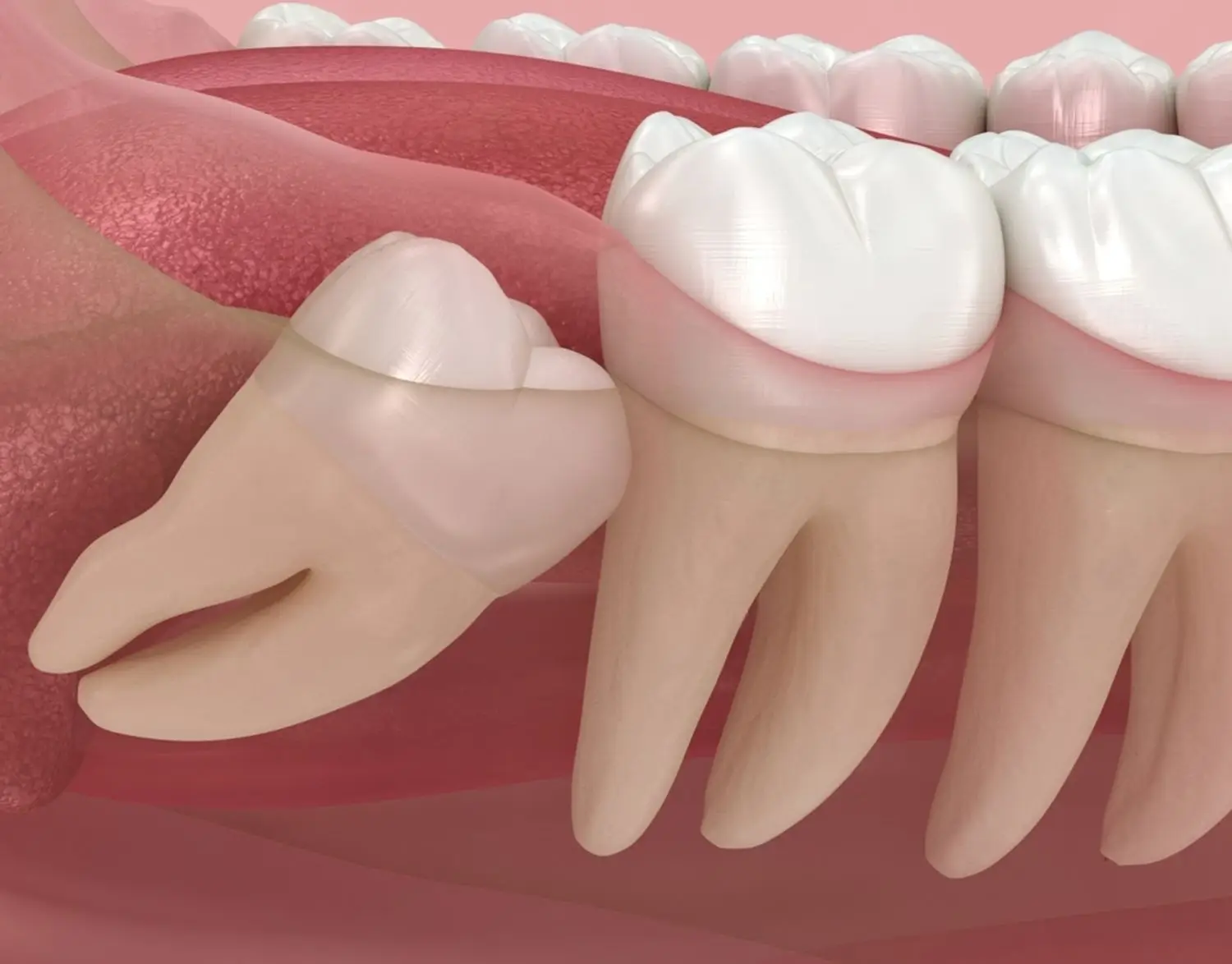
Although they are commonly known as wisdom teeth, professionals refer to them as third molars. The main issue is that our jaw often does not have enough space for them. These are the warning signs you should not ignore:
- Pericoronitis (Infection): When the tooth partially erupts, it creates a gum “pocket” where bacteria accumulate and are impossible to clean.
- Damage to the adjacent tooth: The wisdom tooth may grow at an angle, pressing against the root of the second molar.
- Acute pain and inflammation: Red gums, bleeding, or difficulty opening the mouth.

What is the procedure for removing a wisdom tooth like?
The process varies depending on the position of the tooth and usually lasts between 20 and 60 minutes. It is mainly divided into two types:
| Type of Extraction | Procedure Description |
|---|---|
| Simple Extraction | For fully erupted teeth. An elevator is used to loosen the tooth, and forceps are used to remove it. |
| Surgical Extraction | For impacted or gum-covered teeth. It requires an incision, possible bone removal, and sectioning of the tooth for extraction. |
Does removing wisdom teeth hurt?
No, the procedure itself does not hurt. Thanks to local anesthesia or sedation, the area is completely numbed. During the procedure, it is normal to feel some pressure or movement, but not sharp pain.
Pain usually appears once the anesthesia wears off (between 2 and 6 hours later), but it is manageable with the medication prescribed by the specialist.
Recovery and post-operative care
Recovery time depends on the complexity of the procedure. Below is what you can expect:
| Stage | What to expect and care |
|---|---|
| First 24 hours | Mild bleeding and clot formation. Avoid suction or vigorous rinsing. Apply ice to reduce swelling. |
| Days 2 to 10 | Pain gradually decreases. Liquid or cold diet (3–5 days) and relative rest (3–7 days). Gentle saltwater rinses after the second day. |
| Following weeks | Stitch removal (7–10 days). Normal activity in 5–10 days. Complete bone healing over several months. |
Is the post-operative period painful?
Thanks to the techniques we apply as dentists in Palma de Mallorca, the surgery itself is painless. The post-operative period requires patience: maximum swelling occurs at around 48 hours, but it is manageable with the medication plan we provide.
Essential care after extraction
For fast healing and to prevent infections (such as dry socket), follow this schedule:
| Day | Recommended action | What you should NOT do |
|---|---|---|
| Day 1 | Apply external ice and follow a cold diet. | Do not spit or rinse. |
| Days 2–5 | Very gentle rinses. | Do not smoke or exercise. |
What is recovery like after wisdom tooth removal?
Recovery after simple extraction
Initial healing usually occurs within 7 to 10 days. During the first 24 to 72 hours, it is recommended to bite on gauze to form the clot, apply local cold, and avoid vigorous rinsing, smoking, or using straws.
From the third day onward, swelling decreases, a soft diet can be maintained, and careful oral hygiene resumed. Complete bone healing may take between 2 and 6 months.
Recovery after surgical extraction
Recovery is longer due to incisions and sutures. Swelling usually peaks between the second and third day and may affect the cheek and neck. Pain is controlled with prescribed medication.
Sutures are usually removed between 7 and 10 days. Normal activity can be gradually resumed, avoiding tobacco, alcohol, and hard foods for at least one week.
Frequently Asked Questions
At what age is it best to remove wisdom teeth?
Ideally between 16 and 25 years old. The roots are not fully developed and the bone is more flexible, making extraction and recovery easier.
How much does wisdom tooth removal cost in Palma de Mallorca?
It depends on the complexity. We perform a prior X-ray to give you an exact quote. If you need a trusted dentist in Palma de Mallorca, we are here to help.
How long does wisdom tooth surgery take?
It depends on the complexity. A simple extraction may take about 20 minutes, while surgery for an impacted tooth may take between 45 and 60 minutes. In all cases, it is an outpatient procedure and you will go home the same day.
Is it normal to feel a “hole” after extraction?
Yes, this is completely normal. That space is called the socket and is where the tooth was. Over the following weeks, the gum tissue and bone will gradually regenerate and fill it completely.
When can I eat normally again?
You should maintain a soft, cold diet for the first 3 to 4 days. After a week, if there is no pain, you can gradually reintroduce solid foods. Avoid foods with small seeds (such as sesame or chia) or rice, as they may become trapped in the wound.
What is dry socket and how can I prevent it?
Dry socket is the most common complication and occurs when the blood clot is dislodged too early, leaving the bone exposed. To prevent it: do not smoke, do not use straws, and do not spit forcefully during the first 48–72 hours.
Can I work the day after wisdom tooth removal?
If the extraction was simple, you may return with minimal discomfort. However, if it was a complex surgery involving lower wisdom teeth, it is best to keep complete rest for 48 hours to control swelling and avoid bleeding caused by physical effort.
Can all four wisdom teeth be removed at once?
Yes, it is possible and very common, especially under conscious sedation. The advantage is that you only go through one recovery period and one course of antibiotics. As a dentist in Palma de Mallorca, we evaluate each case to determine whether it is advisable to do it all at once or in two sessions.
It depends on the complexity. We perform a prior X-ray to give you an exact quote. If you need a trusted dentist in Palma de Mallorca, we are here to help.